Rudranath Trek Guide: My Four-Day Solo Panch Kedar Journey
Village Wanderlust · Himalayan journeys
This Rudranath trek guide pairs a demanding Panch Kedar journey with my two-part Tamil travel story. Forest paths and high mountain meadows lead to the remote shrine. Use the video as a personal travel record and the notes below as a starting point for planning—not a fixed schedule that every trekker should follow.
When the body tires, the story changes
Even now, I sometimes ask myself: did I really go there and complete the Rudranath trek? I remember the leeches, the mist and the thunder that felt directly above my head. But I also remember tea made by a quiet old man, the sound of a damru, and a family who stayed beside me on the way back.
Before the trek
A room that did not feel right
After saying goodbye to Eddie, I thought of extending my stay at the place where we had spent the night near Gopeshwar. The uncle would not reduce the price of that room. He showed me another one, initially quoting ₹1,500 and eventually agreeing to ₹800.
It was small, with an outside Indian-style toilet. There were alcohol bottles in the room, and I did not feel comfortable staying there. I apologised and told him I really could not stay. He said it was my choice. I packed everything again and left.
Before the trek
Finding Sagar by accident
I headed towards the Chopta road because I remembered seeing homestays that way. The funny part is that I had imagined Sagar, the Rudranath starting point, was towards Badrinath. Before leaving Gopeshwar, I looked up a homestay and called. They said a room was available. About ten minutes later, I reached it—and discovered I was already in Sagar.
I could not even scold myself. I was relieved to have found somewhere that felt good.
The place was called Karthikeya Homestay. A grandfather, a mother and her son ran it, and he agreed to ₹900 without food. As usual, I managed with aloo paratha in the morning and dal chawal at night.
There was Wi-Fi, but the internet was not working. Between the network problem and how I was feeling, my attempts to work on the videos failed again. Can you imagine being alone, wandering through the Himalayas from temple to temple? I had not told my family or friends about the network problem.
Day 1
Following arrows into the forest
I remembered a board I had seen while travelling to Gopeshwar and assumed that was the way to begin. I followed that side. Only later did I realise I had taken a harder approach rather than the usual starting route. This is a memory of my experience, not a set of trail directions.
Someone asked whether I knew the route before I set off. I said yes—but soon I was looking for the path, with no other walkers in sight. There was a starting-point board, small arrows and the sound of birds. The dense forest even reminded me of the Tamil film Guna. I kept telling myself, “Hopefully I can make it.”
Finding a small shop along the way brought real happiness. It was a difficult trek, and those little signs of people mattered. I was watching for arrows and cloth markers; after the rain and wind, parts of the trail were hard to make out.
From the trail: a moment in the mountains
My Rudranath “Trails” reel captures a small moment on the green mountain slopes. It belongs to the same journey, even though a short clip cannot show everything the walk demanded.
If Instagram does not load here, open the original trail reel.
Night 1
Tea, a little signal, and thunder overhead
By the time I stopped, I was exhausted. Walking alone through mist, with leeches and uncertain weather, had taken its toll. I decided to stop and rest at the tent shelter I found.
There was a mobile signal at that stop. Friends and family contacted me and made sure I was okay. A quiet old man looked after me there. He did not say much, but he prepared tea and food. In that place, those simple acts mattered.
That night I did not sleep. It was not the cold keeping me awake. Thunder, rain and the storm came together with a sound that felt so close—as though it was happening directly above my head. Even now, remembering it, I wonder how I went through that night.
Day 2
Finding joy without pretending it was easy
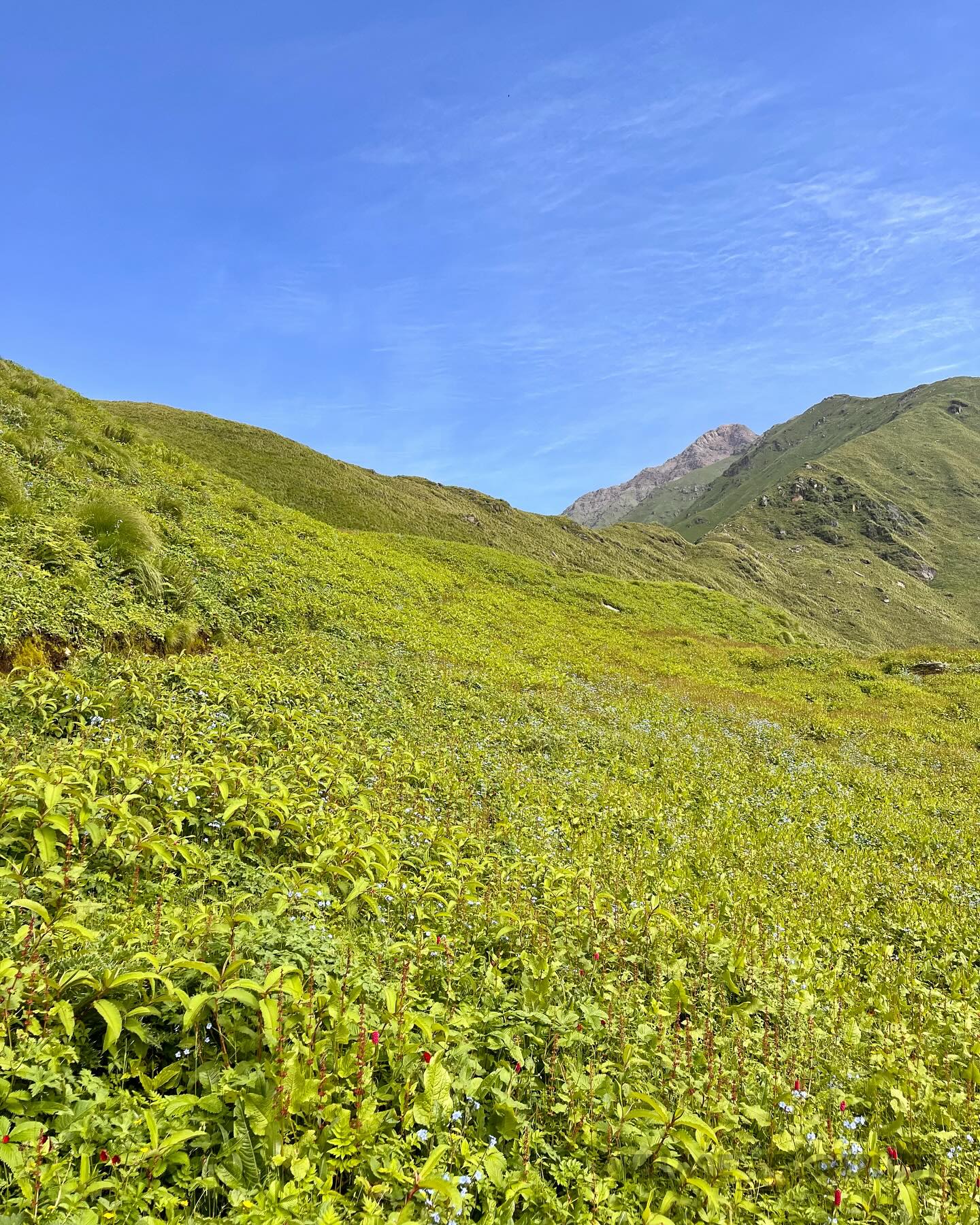
On day two, the weather kept changing—sunshine, fog and rain. I spoke about hail and how cold my hands had become. I was struggling even to talk to the camera. I joked that this pilgrimage was like being told each next stage of life would make everything easier: I kept expecting the next journey to be easier, but Rudranath was proving very hard.
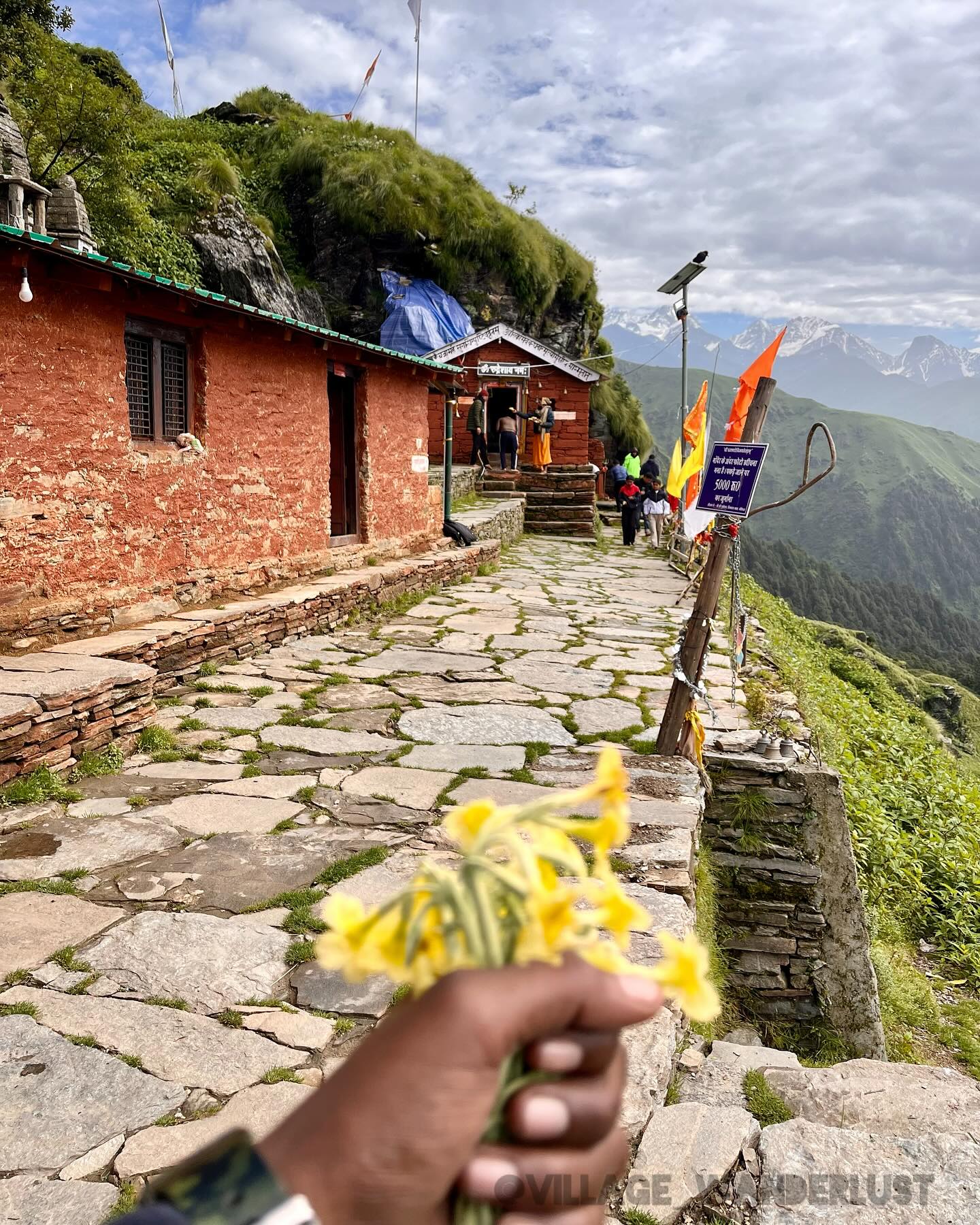
Then there were the yellow flowers. In the middle of the rain and cold, I could still stop to admire them and make a joke. I described this trek as an example of finding happiness within difficulty. The beauty did not erase the struggle; it existed beside it.
Day 2 evening
The temple looked close—but the walk was not over
When the temple came into view, I said it felt as though my tiredness suddenly lifted. Yet the final approach took much longer than I had expected. Something that looked close still demanded time and effort.
I did not have the energy for every extra place people mentioned nearby. I wanted to reach Rudranath, the shrine where Shiva’s face is worshipped. By the evening of the second day, I finally reached the temple and attended the evening puja. I was really there. The temple I had been walking towards was no longer somewhere in the distance.
Night 2 and morning 3
Two bedsheets and the sound of a damru
The night near the temple was another challenge. I could not find a restroom nearby and had to go outside. I managed the cold with two bedsheets. I thought I was alone there, until a family arrived: a husband, his wife and her mother.
At the morning puja, everyone was looking towards the temple. The priest played the damru near me. The sound did something inside me that I still find hard to explain. Was I about to cry? No—let me just pray.
For me, reaching Rudranath felt like a gift. I felt that Shiva had chosen and guided me there; I could not imagine entering that place without his guidance. He is the ultimate truth to me. Those are the words that come closest to what this pilgrimage meant inside.
Day 3
The family who stayed beside me
The family came with me on the way back. They shared snacks and stayed with me through the descent. After so much walking alone, I had people beside me.
The return was hard. We reached a place to stay at around ten at night and stopped there. Imagine how long that day had been. Reaching the temple had not meant the difficult part of the walking was finished.
Day 4
Only a hundred metres from my room
The next morning, we came down to the usual starting point—the one most people used. I realised I had missed it too because I could not read the Hindi words. My room was only about a hundred metres away. All I wanted was to get back and lie down.
I could not find the husband when it was time to say goodbye, so I said goodbye to his wife and her mother. Back in my room, I realised I had not taken their number. They had mine, but I had no way to call them. The trek had ended, and suddenly they were no longer around.
At the time, I was too tired to understand much beyond the relief. Later, I thought about how different it all had been: arriving alone, being cared for, walking back with a family, and not even exchanging numbers properly before parting.
I felt so relieved. I thought the hardest part was over.
But the truth was, it was only the beginning.
From my Part 1 narration: finding the route · 1:37 · deciding to stay · 16:15 · weather and reflection · 21:08 · flowers and the temple ahead · 23:34.
My experience is not advice to continue in poor visibility or severe weather. Stop safely and follow local guidance. Plan overnight stops around conditions and your fitness, with room to rest or turn back.
A moment from Rudranath
The original Rudranath caption contrasts physical exhaustion with mental determination. The reel gives a personal glimpse of the effort behind the journey—not a promise that the same pace suits everyone.
This compact reel is served by Instagram. If it is unavailable or a privacy setting blocks it, open the original post.
Watch the Rudranath journey in Tamil · Both parts
This journey has two chapters. Begin with Part 1, then watch Part 2 to continue my Rudranath solo-trek story.
Part 1 · Rudranath
Part 2 · Rudranath
Why Rudranath feels different
Rudranath is a Shiva shrine in Chamoli district, Uttarakhand, and one of the five Panch Kedar temples. Shiva’s face is worshipped here. The Chamoli district website identifies Sagar as an approach to the temple.
In the Panch Kedar legend, the Pandavas seek Shiva after the Mahabharata war. Shiva takes a bull’s form; the places where different parts appear become the five shrines, with the face associated with Rudranath. This is sacred tradition rather than a documented construction history.
Wikipedia’s Rudranath article describes the natural-rock shrine amid forests and alpine pastures, and the winter movement of a symbolic image to Gopinath Mandir in Gopeshwar. These details offer background to the pilgrimage, separate from the personal experiences above.
Read those sources for background, and confirm current temple access, worship arrangements and trail conditions locally before planning a visit.
Choosing a Rudranath trek route
Routes are commonly planned from villages near Gopeshwar, including the Sagar side, while other longer combinations connect through different valleys. Distances, overnight halts and trail conditions vary. Confirm the currently usable route locally instead of relying on an old map or a single online itinerary.
- Allow: Enough time for the route, weather and your pace. My journey continued into a fourth morning; plan travel and buffer time separately.
- Difficulty: Difficult because of distance, climbs, altitude and limited facilities.
- Best for: Prepared trekkers who are comfortable with basic stays.
- Guide: Strongly worth considering for solo travellers and first-time visitors.
Accommodation and food
Seasonal shelters, village homestays and very basic lodges may operate along the popular route. Availability can change, so confirm halts before starting. Carry emergency food even if meals are expected. Simple dal, rice, roti, vegetables and tea are typical; water should be treated or obtained from a trusted source.
Essential packing list
- Broken-in trekking shoes and spare socks
- Warm layers, waterproof jacket and pack cover
- Headlamp, power bank and offline map
- Water purification and high-energy snacks
- First-aid kit and personal medication
- Cash, identity documents and emergency contacts
- Walking pole for steep ascents and descents
Safety and responsible travel
Begin early, never continue blindly in fog and listen to shepherds, hosts and local guides. Monsoon rain can make slopes unstable, while early or late season can bring snow and cold. Mobile signal is unreliable. Register where required, inform someone of each day’s plan and carry back every piece of non-biodegradable waste.
Rudranath trek FAQs
Is Rudranath the toughest Panch Kedar trek?
Many pilgrims consider it among the toughest because of its long approaches and limited facilities. Difficulty depends on the chosen route and current conditions.
Can beginners do Rudranath?
A beginner should build endurance beforehand, allow extra time and strongly consider a local guide. It is not a good trek to rush.
What is the best time to visit?
The pilgrimage season generally falls between late spring and autumn, avoiding severe winter. Post-monsoon skies can be clearer, but every trip depends on current temple dates, rain and trail status.
For more journeys across sacred Uttarakhand, read my Gangotri Yatra story and subscribe to Village Wanderlust on YouTube.
This is personal travel experience, not a live trail advisory. Verify conditions locally and use official Uttarakhand information before starting.
